


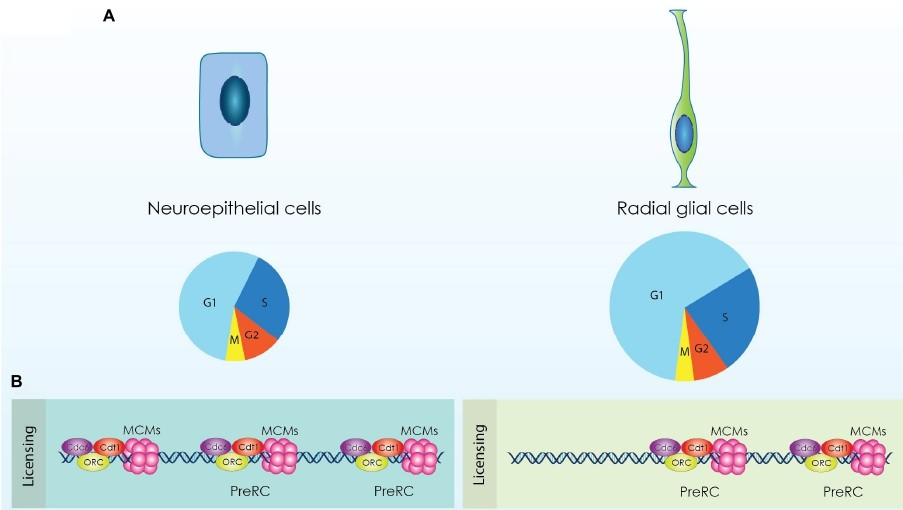
The diverse populations of neural stem cells (NSCs) that emerge during cortical development exhibit distinct cell cycle kinetics and differential regulation of the DNA replication licensing and initiation processes. Neuroepithelial cells are characterized by a shorter cell cycle compared to Radial Glial cells that permits their fast proliferation. During the G1 phase origins of replication are licensed by the formation of a competent pre-replicative complex (Pre-RC). Higher expression of licensing factors (ORC, Cdc6, Cdt1 and MCMs) is required for the efficient licensing of origins in NECs that exhibit a shorter G1 phase.
Cortical Development and Brain Malformations: Insights From the Differential Regulation of Early Events of DNA Replication
Origins of replication are licensed during the G1 phase by the formation of a competent pre-replicative complex (Pre-RC). Impaired licensing and initiation of DNA replication lead to defective brain development and microcephaly. Reduced expression of licensing factors results in decrease of licensed origins that further causes incomplete initiation of DNA replication. Aberrant licensing directly affects the successful duplication of the genome due to under-replication or over replication. Under these conditions, the proliferation of NSCs is compromised resulting in severe brain malformations.